- Memory is not judgment: assistants now remember what you told them; what they lack is how you decide, which is what Duplikate builds.
- Built from your own record, every piece cited: your engram is a set of nodes, each pointing to where you said it, that you can read, correct and delete.
- Measured against you, with no score until the test has run: it is graded on decisions you already made, and our own founder’s record goes first.
- It asks before it acts: it drafts and prepares decisions, and you approve what goes out.
Key takeaways
Today we are opening duplikate.io. Duplikate is a Traide product: an AI helper that works the way you do, built from your own record, measured against you, and kept under your control. It exists because the assistants already remember facts about you, and none of them knows how you decide. This post says what Duplikate is, why we built it, how we will know whether it works, and what it will not do.
Memory became free. Judgment did not.
Over the past year, remembering you stopped being a product and became a setting. The big assistants keep what you tell them, and a few will import it from each other. That is useful, and it is not the hard part.
The hard part is the call only you would make. The discount you would give this buyer and not that one. The supplier you stopped using and the reason. The way you turn down a request without losing the relationship. For a founder, an operator or a senior expert, those calls arrive every week, and the person who can make them is the bottleneck. A memory of facts does not help, because the facts were never the problem.
What an engram is
We call the thing Duplikate builds an engram: a working record of how one person decides. It holds the rules behind their calls, the options they have ruled out and why, and how they say things. Each piece is a node that cites where the person said it, so every answer the helper gives shows its source, and any node can be read, corrected or deleted.
It is built from the person’s own record: the mail they sent, the reviews they gave, the notes they kept. Nothing ambient goes in. There is no microphone and no screen capture. Mail they received is context for their replies, never a source, and the people named in it become roles, like “a buyer at a restaurant group”, before anything is stored. We train no model on you: the AI retrieves your nodes when it works for you, which is how you can inspect every piece and take it with you.
A helper then uses the engram to draft, triage and prepare decisions, and you approve what goes out. When you correct a draft, the correction comes back as a proposal you keep or discard, so it learns only what you agree it should.
Our own record first
We did not want to ask anyone to trust a pipeline we had not run on ourselves, so we built it on our founder’s record first: years of the founder’s own replies and the decisions in them, extracted into nodes, with every name turned into a role at the door and every node tied to its source. Duplikate is built on that same pipeline, and the founder’s record is where the measurement below runs first.
How we will know whether it works
It is not you. It is measured against you. We hold back decisions you already made, replay each situation, and count how often your engram would have done the same. Nobody agrees with themselves every time, so the ceiling is your own consistency: we re-ask a sample of your decisions later, and report the score as a fraction of that, with its margin.
There is no score on duplikate.io yet, on purpose. The test runs on our own founder’s record first, and when it has, we will publish the result, whatever it is, with its interval and the size of its sample. A product whose claim is “it decides like you” should have to show the number, and should not get to choose which number to show. The fidelity page sets out the method now, so the result can be read against it when it lands.
What it will not do
It will not pretend to be you. Duplikate writes. It does not imitate your voice or your face.
It will not act without asking. Nothing goes out, gets paid or gets promised without your approval, unless you set a standing rule inside a limit you set, and at launch there are no standing rules for money or commitments.
It will not hide that it is an AI. Every message it drafts is to carry a visible line saying so, and a machine-readable marker. That commitment, and the others about export, deletion, training and what happens if we are sold or close, are on the Trust page, each marked live where it is true today and planned where the product makes it true before it builds your engram.
Human-Friendly, AI-Optimized, applied
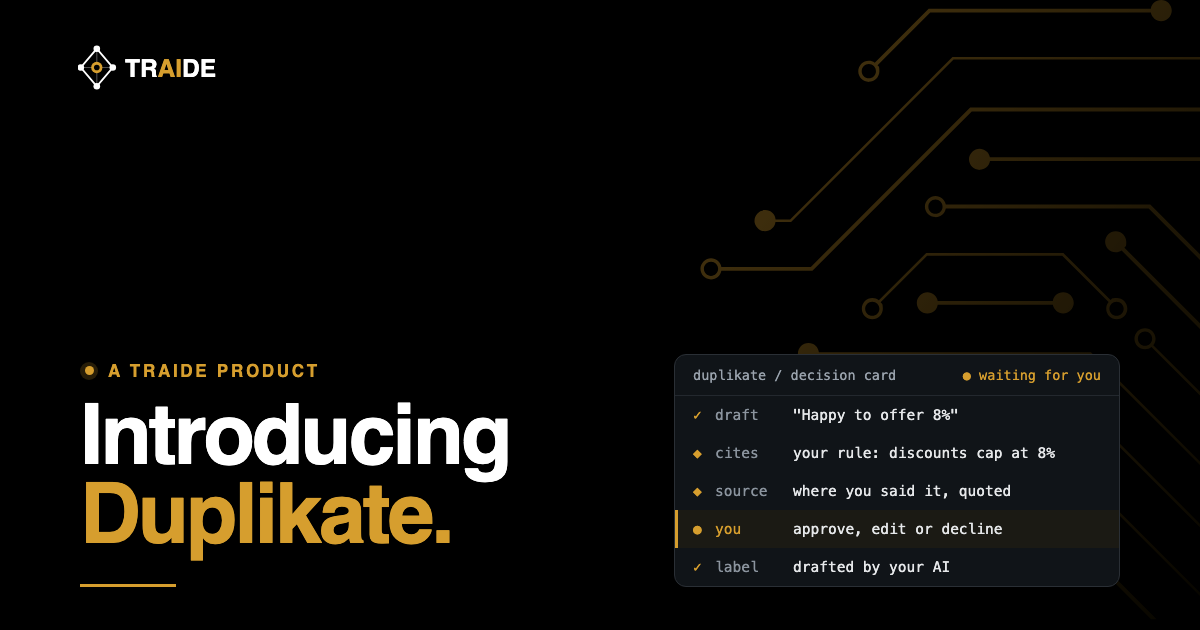
Duplikate is the clearest case we have of the way Traide works. The AI does the volume: reading the record, drafting, triaging. The person holds the irreversible: what goes out in their name, and what it learns. Decisions arrive as decisions, a card with the options, a recommendation and the rule it rests on, never a thread that ends in “let me know”. And everything it did is on record, with its source.
What happens next
The first builds are scoped one at a time, in writing, before anything starts: which sources go in, how the engram is measured against you, and what it costs. If your judgment is the bottleneck in your work, start on duplikate.io, or read how Traide builds an engram first.